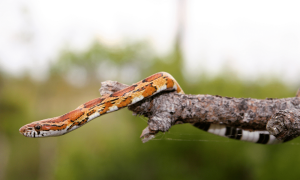
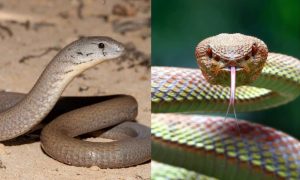
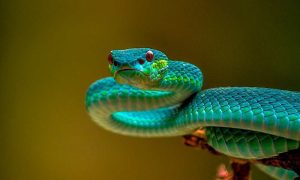
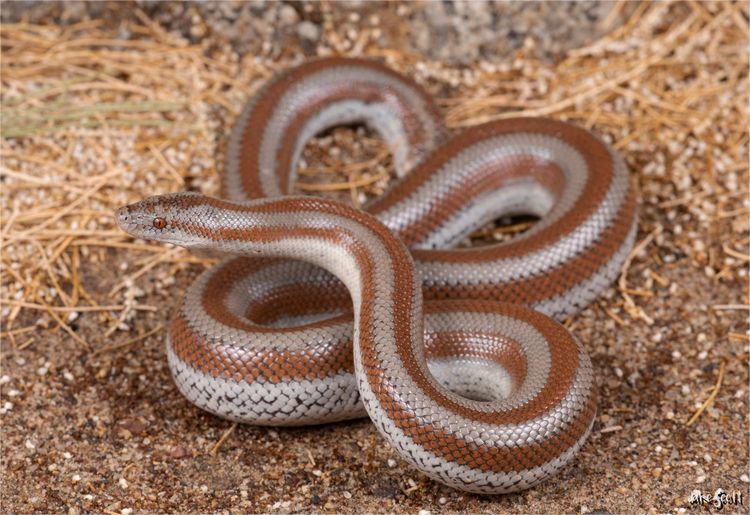
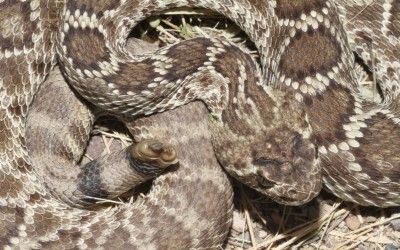
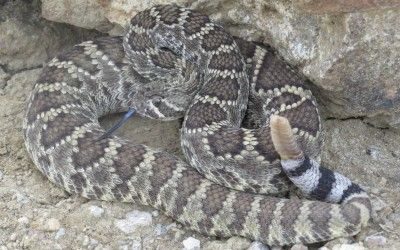
Because of what seems to be an innate irascibility and a dangerously complex venom, this species should be considered a very dangerous taxon. This snake will often stand its ground and may even approach a human while striking. Keep a safe distance. This is a feisty 2 ½ to 4 foot long rattlesnake. This species can be easily mistaken for a western diamondback. Ground color brownish to greenish. This species has an irregularly banded tail, with the black rings being narrower than the white spaces between; snout and crown scales are usually noticeably enlarged; 2 light facial stripes foremost diagonally from in front of eye to and following jawline rearward, 2nd from behind eye diagonally to posterior to the jaws. Note the vertical pupils and infrared sensing pit between, but lower than, the nostril and eye. Scales keeled. Ovoviviparous. Juveniles similar to adults
Unique Features:
The large crown and snout scales are difficult to see. The irregular banding of the white and black tail is easier. Use your range map
Habitat and Diet:
This rattlesnake is most often encountered in rocky, or chaparral shrouded deserts, canyons, arroyos, and on roadways traversing these regions. It is most active at dusk and after dark when temperature is moderate. Preys on rodents and ground nesting birds as well as lizards






![Get medical help as soon as you can (dial 911 or call local Emergency Medical Services [EMS]). Serious snake envenomation is treated with antivenin.](https://semhandyman.com/stag/wp-content/uploads/2023/12/WhattodoifYouAreBittenbyaVenomousSnake-300x180.png)