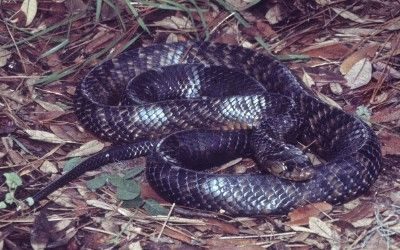
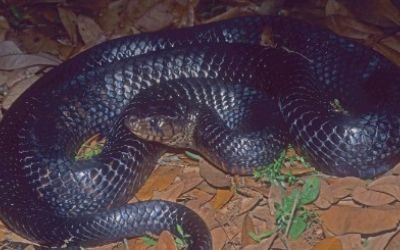
THIS IS A PROTECTED SPECIES THROUGHOUT ITS RANGE. Long (to 7+ feet), heavy bodied, and variably dispositioned describe this Texan. Shiny brownish scales anteriorly shading to black posteriorly. Black lines from eye to lower labial (lip) scales. Darker barring is usually visible anteriorly. Smooth scales in 17 rows. Unlike most of the large, heavy bodied snakes in the USA, the indigo snakes are not constrictors. Rather, they grasp and hold prey with their strong jaws and at least partially immobilize it by holding it beneath a coil. Oviparous. Hatchlings (which may be 2 feet long!) may be all dark or strongly patterned with irregular blue flecking. Prey consists of mammals, birds, amphibians, and reptiles (including venomous snakes).
Unique Features:
This is an immense, heavy bodied, snake. Shiny brownish scales anteriorly shading to black posteriorly. Black lines from eye to lower labial (lip) scales. Darker barring is usually visible anteriorly
Habitat and Diet:
Grasslands and brushlands, usually near water. Prey consists of mammals, birds, amphibians, and reptiles (including venomous snakes)






![Get medical help as soon as you can (dial 911 or call local Emergency Medical Services [EMS]). Serious snake envenomation is treated with antivenin.](https://semhandyman.com/stag/wp-content/uploads/2023/12/WhattodoifYouAreBittenbyaVenomousSnake-300x180.png)