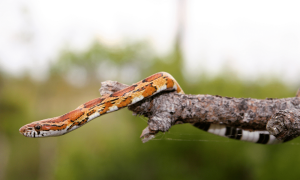
Adult at 2 ½ to 3 ½ feet with some individuals attaining 5 feet in length. Despite being afforded a species name, this snake of western canyons, rockslides, hill country and other harsh habitats is, in appearance, and probably in actuality, a dingy western corn snake. Primary color is brown to gray and the darker saddles and lateral spots are edged in black. The belly is checkered black and off-white and the underside of the tail (subcaudal area) is striped. Colorado examples have very narrow dorsal saddles. Scales are smooth on the sides and weakly keeled on the back. Oviparous. Hatchlings are similar to the adults. Rodents, birds, and lizards are the preferred prey items of this powerful constrictor.
Unique Features:
Forward pointing spearhead on the top of the head and coloration are identifying features.
Habitat and Diet:
Primarily a ground dweller in canyons, rockslides, hill country and other harsh habitats as well as brush, open woodlands, and ranchlands. Rodents, birds, and lizards are the preferred prey items of this powerful constrictor.





![Get medical help as soon as you can (dial 911 or call local Emergency Medical Services [EMS]). Serious snake envenomation is treated with antivenin.](https://semhandyman.com/stag/wp-content/uploads/2023/12/WhattodoifYouAreBittenbyaVenomousSnake-300x180.png)